
Development Without the Developmental State
Poland, Estonia, and Mauritius each met the underlying conditions that drove East Asian transformation.

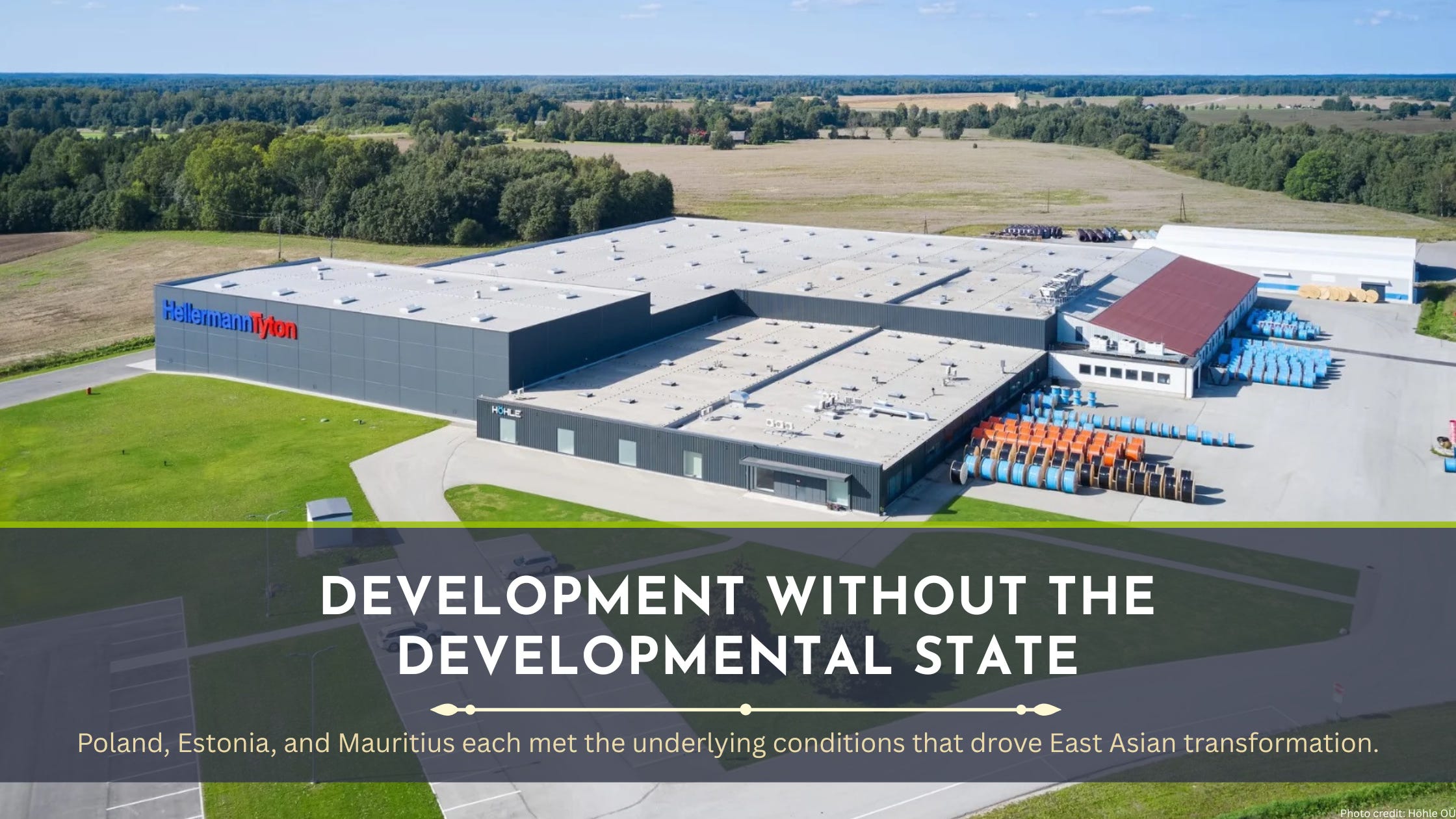
Singapore, Taiwan, and Korea directed investment toward designated industries and insulated economic decisions from political demands for redistribution. Three conditions define transformation-oriented governing: declared developmental intent, costly commitment, and a governing circuit that carries both into productive domains. This post asks whether the same underlying conditions have been met by governing systems that look nothing like those of East Asian countries, using instruments that those goverments never used.
East Asia built sustained development through authoritarian governments with directive economies. From these cases comes the standard account: strong state authority directing structural transformation, insulated from democratic politics. The developmental state is one way to meet those conditions, but its policy instruments are not the conditions for governing orientation. The developmental state literature studied East Asia, identified those instruments, and treated them as the definition of transformation-oriented governing, carrying that logic into policy design, reform programmes, and development assistance: the instruments became the criterion. That argument is compelling. Taken as a template, it is also limiting.
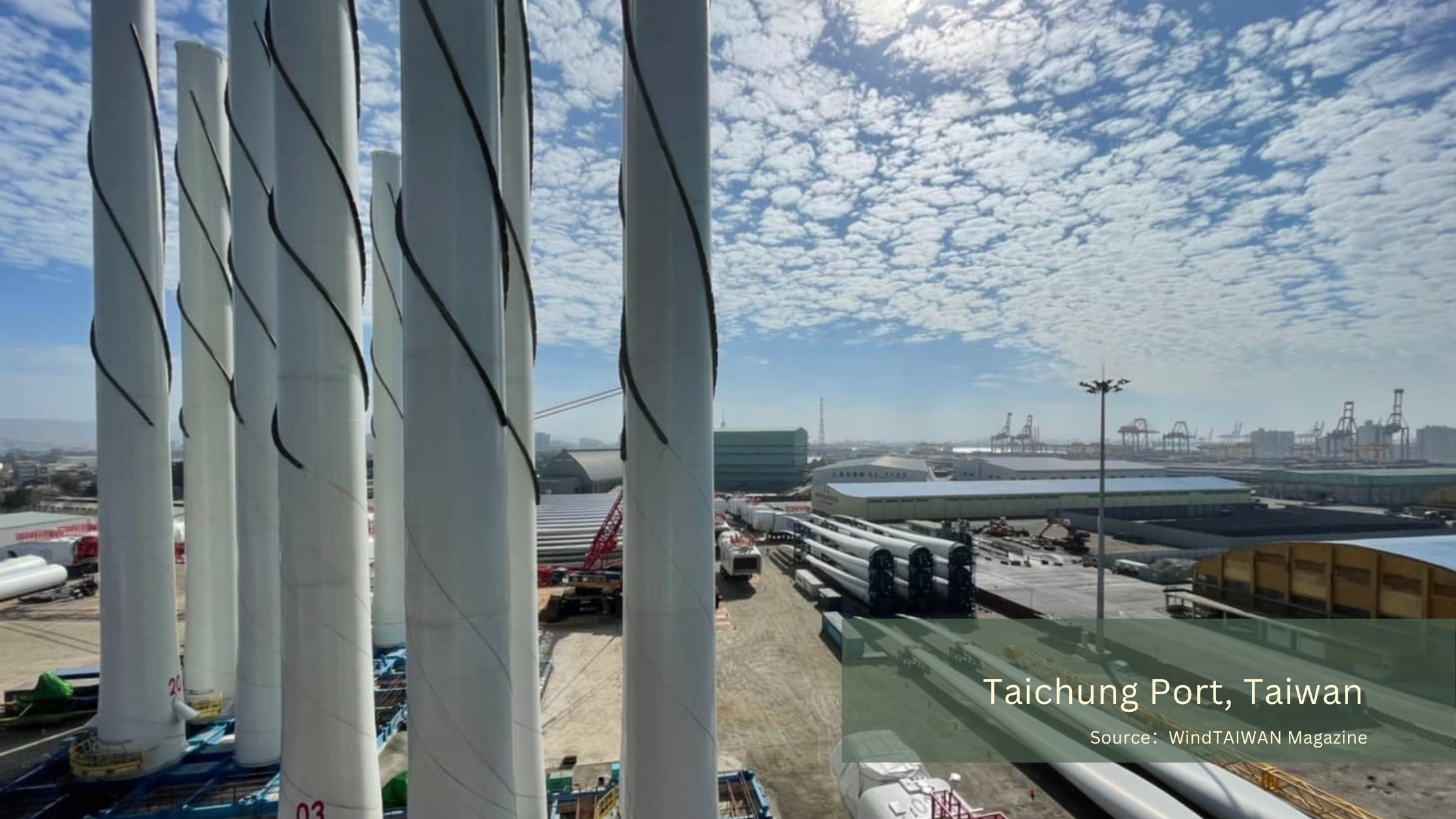
Democratic market economies cannot replicate that policy package. They operate with competitive political environments and coalition governments that must regularly satisfy distributional pressure. Available instruments are different, but the underlying requirements for transformation are the same. Three cases from different political economies show what meeting them looks like without the East Asian toolkit.
Three Democratic Transformations
Poland, 1990. Mazowiecki’s newly elected government gave Leszek Balcerowicz a mandate to convert an economy running 600 per cent annual inflation and collapsing output into a functioning market system.
Price liberalisation, subsidy elimination, current account convertibility, hard budget constraints: Balcerowicz assembled the full package against the interests that had organised under the prior system and would bear the costs first.1
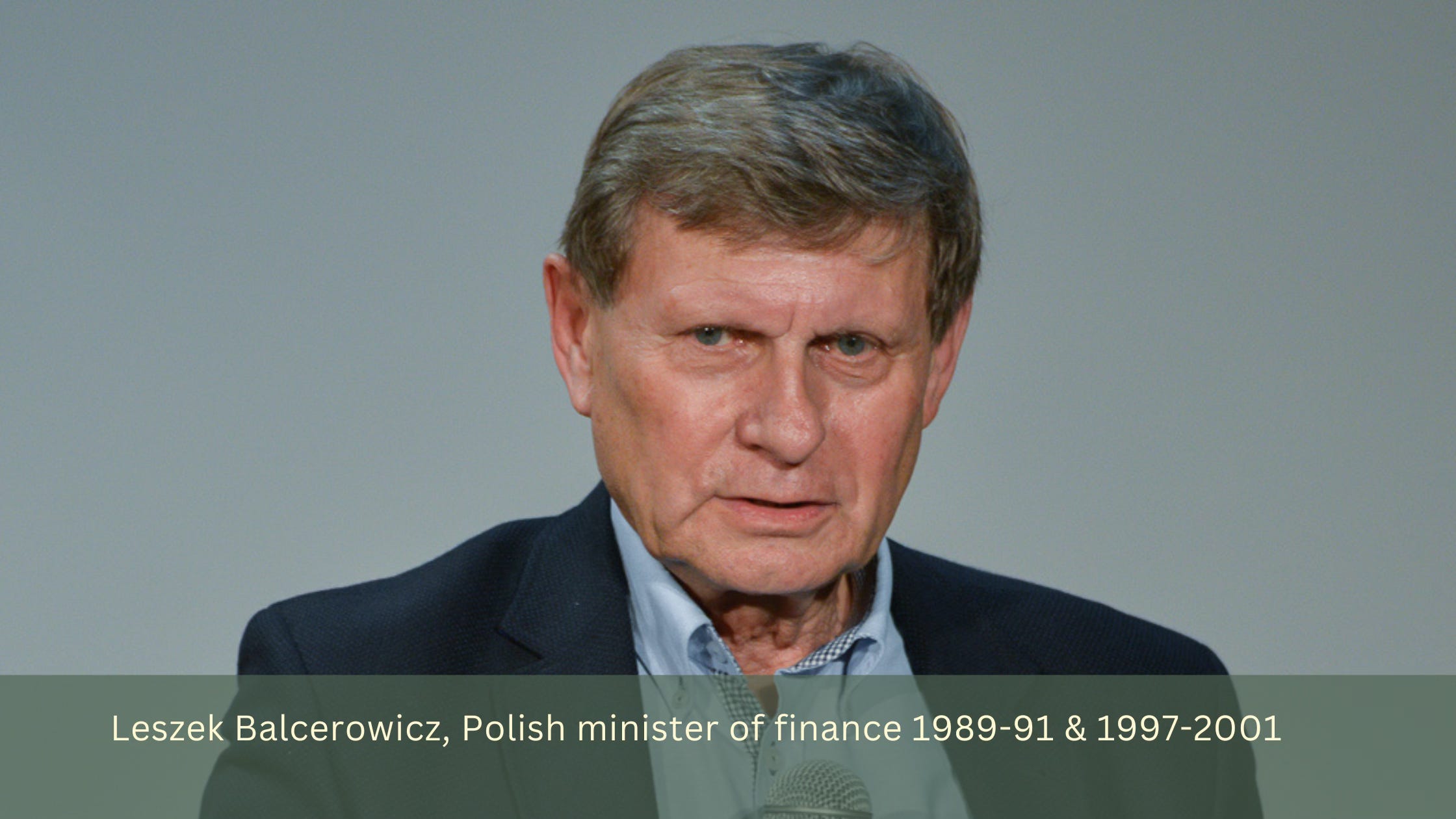
That is what declared developmental intent looks like through the democratic mode: not a directive allocation of investment toward designated industries, but an accountability standard the governing coalition asked to be judged against.
Estonia, 1992. Estonia’s government inherited a Soviet command economy and chose not to reform it gradually. Developmental intent was declared: a functioning market economy and EU membership as the measurable goals. A flat income tax replaced the Soviet-era rate structure. Tariffs were eliminated. The Bank of Estonia was stripped by constitutional statute of the ability to expand credit in response to political pressure, against IMF advice.
The commitment was costly, imposed before the new system had proved it could hold. Real GDP contracted about 30 per cent before the turn. Industrial production fell by more than half. Real wages dropped 45 per cent in 1992 alone. All of it was absorbed before any payoff was visible.2
Its governing circuit took a different form from the East Asian model: not a ministry directing investment flows but a civil service rebuilt from scratch without Soviet-era staff, and an independent data exchange layer (X-Road, 20013) that made state services transparent and resistant to capture. When the Laar government fell to a no-confidence vote in November 1994, the incoming coalition lacked the absolute majority to repeal the currency board. The commitment outlasted the government that made it.4
Mauritius, 1970. The island had been independent for two years. Its economy was a monoculture: sugar, controlled by a small Franco-Mauritian landed elite. The founding government’s declared intent was explicit: a productive economy outside the sugar monoculture, built through an Export Processing Zone with different rules, different wages, and a different productive logic.
The commitment was costly: the founding Labour government chose not to redistribute the sugar estates, the move its electoral base expected, and instead built a competing productive sector.
The governing circuit rested on concrete institutional machinery: the Development Bank of Mauritius channelling capital toward EPZ industries, an investment promotion authority that became the Board of Investment, maintaining consistent terms for inward investors across six decades, and the Bank of Mauritius as the monetary anchor.5
When the Mouvement Militant Mauricien ended Labour’s founding hold in 1982, it extended rather than reversed the EPZ: the circuit outlasted its founders. When Asian competition mounted in the garment sector through the 1990s, successive governments built out financial services rather than defending declining industries: it served a productive purpose rather than the distributional interests of the coalition that built it. A framework that survives both political alternation and market adversity is confirmed in a way that surviving only one cannot confirm.
Three countries, different regions and political economies. Poland emerged from the Soviet collapse; Mauritius from colonial rule; and Estonia from occupation and rapid independence. None reproduced the East Asian developmental state: no pilot agency directing investment flows, no directed credit disciplining firms against export targets. What they share with Korea and Taiwan is not the instruments but the underlying structure: a governing commitment that absorbed prior cost, held under pressure, and operated through institutional machinery that no subsequent distributional politics has yet reversed. All three met those conditions through democratic instruments: Poland through a declared accountability standard, Estonia through a self-binding circuit that outlasted the government that built it, and Mauritius through a productive framework sustained across fifty years of political alternation.
Not Anomalies
In 1967, Botswana’s founding government committed unconfirmed diamond revenues to a development fund rather than to coalition maintenance: the declared intent was national development, not distribution. Its founding president had already surrendered his chieftaincy title as part of the independence settlement, borne before any crisis made the choice necessary. Successive National Development Plans carried the commitment forward. The absence of any forcing event makes Botswana’s founding commitment the hardest to explain away.6

Ireland’s declared target was a high-value export-led economy; pharmaceuticals and technology were the core productive domains the IDA had identified to build it. The 1987 social partnership was the costly commitment that made it credible. The Government, employers, and unions accepted wage moderation and fiscal consolidation — costs falling on the coalition’s own supporters before any recovery justified them. The IDA’s conditional grants, tied to employment and R&D commitments with clawback for underperformance, were the governing circuit: they had prepared those domains through the debt crisis rather than after it. By 2009, pharmaceuticals were close to a quarter of Ireland’s goods exports.7
India’s 1991 crisis produced a declared transformation, real costs on established interests, and circuits that propagated through software parks, competitive telecom, and a reserve bank that held across administrations.8 Aadhaar and UPI, built outside the bureaucratic rotation system, extended the logic into digital finance: financial inclusion was the declared target, operational independence from the rotation system was the commitment, and the National Payments Corporation (NPCI), under Reserve Bank oversight, has been the circuit. India’s transformation has a recognisable domain profile — significant but not economy-wide. But the domains are multiple, and their breadth across the economy is sufficient to mark a governing orientation rather than isolated achievement.9
Three Requirements
Declared intent against an external standard. Each case features a transformation target measured by something other than the government’s own assessment. Korea’s export targets were graded by global markets; Estonia’s EU membership goal was assessed by the EU’s accession requirements. The external standard converts a declaration into a commitment by removing self-grading. What gets declared is determined by political settlement; external verification is structural.
Costly commitment. In every case, the governing coalition absorbed real costs before any outcome justified them, and those costs fell on its own supporters. Sacrifice that falls only on opponents is distributional politics; only sacrifice falling on the coalition’s own constituency is a credible commitment. East Asian costs fell on the firms that the developmental state depended on: failed companies and suppressed consumption. Democratic costs fell primarily on electorates and on the coalition’s own future discretion: GDP contraction, wage cuts, and constitutional constraints that no future government could easily reverse. That costs precede any payoff is structural: it holds across both modes.
Governing Circuit that survives political alternation. The institutional machinery must carry the commitment past the government that made it. Korea’s export discipline outlasted its founding government; Estonia’s currency board survived the fall of the Laar government. The mechanism varies: state control over credit, constitutional entrenchment, commercial law, and institutional independence. The requirement is constant: durability against coalition replacement, not just against short-term political pressure.
These three requirements appear across each transformation case examined. While the political settlement and policy mode vary, the structural requirements do not.
Prerequisites, not Institutions
For any governing system, the question is not whether it has the East Asian institutional package but whether those three requirements are being met through whatever instruments are available. Is intent declared against an external standard? Are real costs being absorbed before any payoff arrives? Is there architecture that will carry the commitment past the next election? Each needs to be established before any transformation outcome exists.
Most existing diagnostic frameworks ask whether a country has the right institutions, rather than whether the three conditions are being met by whatever institutions exist.
These are necessary conditions, not sufficient ones. They are structural conditions, not distributional verdicts: how transformation is governed is a separate question from who bore the costs and who captured the gains.
Democracy does not prevent transformation-oriented governing. It shapes how it unfolds: the goals that can be declared, the costs that can be imposed, and the governing circuits that can be made to hold.
Further Reading
The developmental state tradition this post argues against is best represented in Chalmers Johnson, MITI and the Japanese Miracle (1982); Alice Amsden, Asia’s Next Giant (1989); and Robert Wade, Governing the Market (1990).
Notes
Lipton, David, and Jeffrey D. Sachs. “Creating a Market Economy in Eastern Europe: The Case of Poland.” Brookings Papers on Economic Activity 1990(1): 75–148.
Knöbl, Adalbert, Andres Sutt, and Basil Zavoico. “The Estonian Currency Board: Its Introduction and Role in the Early Success of Estonia’s Transition to a Market Economy.” IMF Working Paper WP/02/96, 2002.
Laar, Mart. “The Estonian Economic Miracle.” Heritage Foundation Backgrounder No. 2060, 2007.
Information System Authority of Estonia (RIA), “X-Road History,” x-road.global.
Subramanian, Arvind, and Devesh Roy. “Who Can Explain The Mauritian Miracle: Meade, Romer, Sachs or Rodrik?” IMF Working Paper WP/01/116, 2001.
Acemoglu, Daron, Simon Johnson, and James A. Robinson. “An African Success Story: Botswana.” In Dani Rodrik, ed., In Search of Prosperity: Analytic Narratives on Economic Growth. Princeton University Press, 2003, pp. 80–119.
Ahluwalia, Montek S. “Economic Reforms in India Since 1991: Has Gradualism Worked?” Journal of Economic Perspectives 16(3), 2002: 67–88.
Consultative Group to Assist the Poor (CGAP), “National Payments Corporation of India and the Remaking of Payments in India,” Working Paper, 2019.
Honohan, Patrick, and Brendan Walsh. “Catching Up with the Leaders: The Irish Hare.” Brookings Papers on Economic Activity 2002(1): 1–78
I am just thrilling to this series, and would be interested if, in a future post, you might look at given countries' trajectories next to their comps. So, in this post's case, Estonia next to Latvia and Lithuania; Mauritius next to Cabo Verde, Comoros, and Trinidad; and Poland next to Bulgaria, Romania, and Ukraine. Where did they start at in terms of GDP per capita at PPP, and where did they end up? What were their starting and ending industrial mixes, production levels, and export-im ratios? What does success look like among situational comps?