
Indonesia Spent Thirty Years Arguing About the Wrong Thing
Its free-market reformers and its industrial planners backed rival roads to development. Both left out the one thing that would have made the difference, so it never mattered who won.

Indonesia halted 600 per cent inflation, rode two oil booms without ruin, fed itself, and pulled most of its people out of poverty.
It wanted more than growth. It set out to become a different kind of economy, and paid real prices to try.
It never arrived. No Indonesian-owned firm became a global technology leader the way Samsung or TSMC did.
Its reformers and planners argued over which road would get it there.
This is about the one thing that sat unchanged under both roads, and why the argument decided nothing.
Indonesia is one of the thirteen economies the World Bank singled out for growing fast enough and for long enough to make its shortlist of sustained success. For most of that run, until 1997, it outgrew its peers. Yet it never joined the smaller group that makes the final leap to becoming rich. Pietro Masina has provided a more contemporary analysis of the current challenges the country’s economy faces. This post looks back at what Indonesia’s state was built to reward, and what its ruling coalition was actually optimising for during its earlier growth period.
In the mid-1960s, with prices rising at around 600 per cent a year and the economy in ruins, Indonesia’s new ruler did something most strongmen never do. Suharto handed the wreckage to a circle of academic economists, most of them trained at Berkeley.
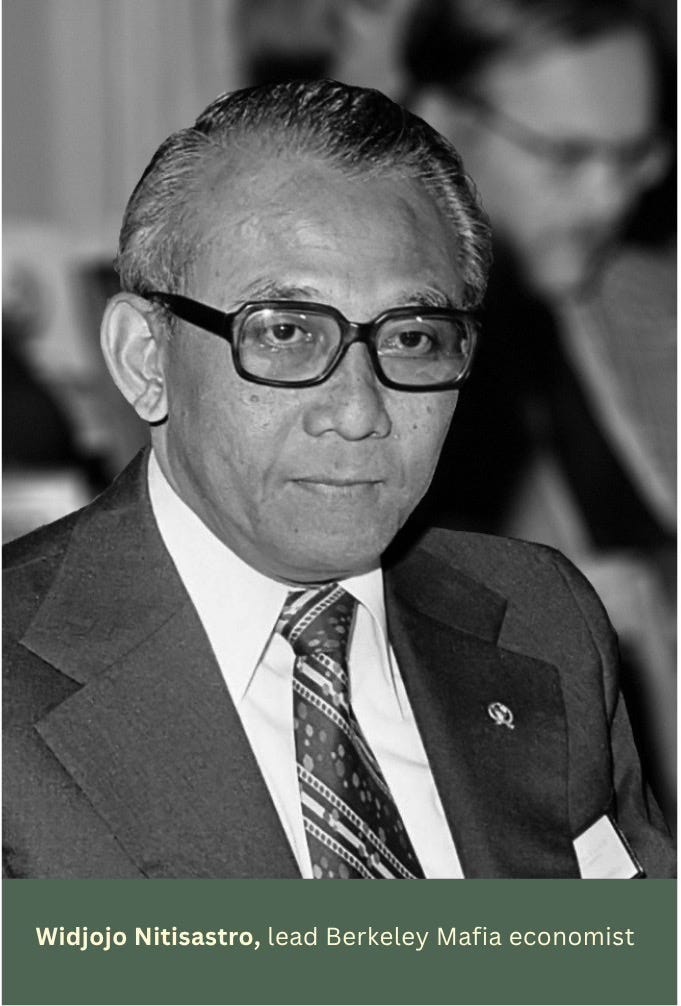
People called them the Berkeley Mafia, and within a few years inflation was in single figures and the foreign lenders had been talked back to the table.1
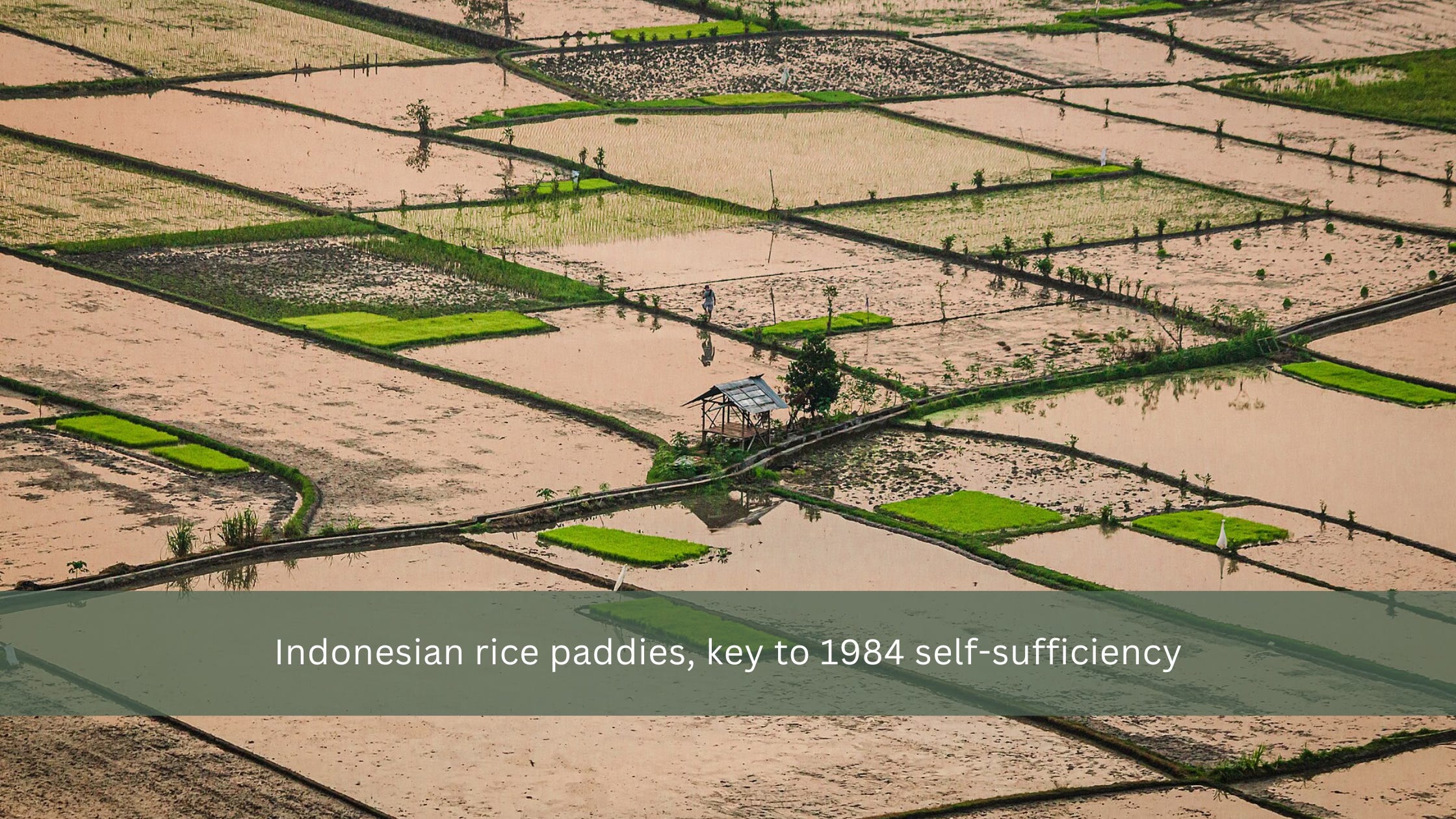
Then came the oil booms of the 1970s, the windfall that wrecked Nigeria and Venezuela.2 It did not wreck Indonesia. In 1978, with no crisis forcing its hand and the oil still flowing, the government deliberately devalued its currency to keep its farms and factories competitive, the prudent move almost no government makes in the middle of a boom. The money went into rice, roads and schools. Indonesia fed itself by 1984. Poverty fell from around 60 per cent of the population in 1970 to about 11 per cent by 1996.3
By the standards of its time, Indonesia did almost everything a poor country is told to do, and did it well. And it still never made the leap to rich. It rose to middle income and stopped there. No Indonesian-owned firm ever reached the technology frontier the way a Samsung or a TSMC did.4 That is the puzzle. Not a country that failed for want of competence, but one that had it in full and stalled anyway.
The country that got it right
Getting it right meant more than running a tidy economy. Plenty of countries manage that and never become rich, and nobody is surprised. What makes Indonesia a genuine puzzle is that it wanted the leap, and paid for it.
Suharto called himself the Father of Development and meant it as a programme, with five-year plans that set targets for industry, not just output. Its planners argued that cheap-labour growth was a trap that would move on the day wages rose somewhere cheaper, so the country had to master real industry or stay poor for good. That was its declared developmental intent, and Indonesia had it in full.
It backed that intent with real political prices. The austerity that broke inflation and the deliberate devaluation in a year of plenty were costly commitments, paid before any reward was in sight, the kind nobody pays unless they mean it. Both were paid to steady the nation’s books, not to make a single firm do well.
And the oil was doing something quieter at the same time. It did not just pay for the rice, the roads and the balanced books. It was also buying the loyalty of the people who kept the regime in power, and buying it with no strings attached.
So the explanation does not appear to be that something was missing. The intent was real, the prices were paid, and the oil meant the money was there too. Indonesia had everything a country is told it needs. If the answer is not in what it lacked, it has to be in what it did with all of it: what its state was built to reward, and what it was content to leave alone. It disciplined its budget without mercy, and its firms not at all.
Indonesia against itself
Indonesia did not pick one development road and hold to it. Over thirty years, as oil prices rose and fell, it ran both rival models the field still argues about. When the oil money was thin, and Jakarta needed its creditors back, the economists won. They took the free-market road: free the banks, deregulate trade, let cheap labour attract foreign factories, take a modest place in the world market, and grow rich slowly.
When the oil flowed, and the state could afford its ambitions, the engineers won.
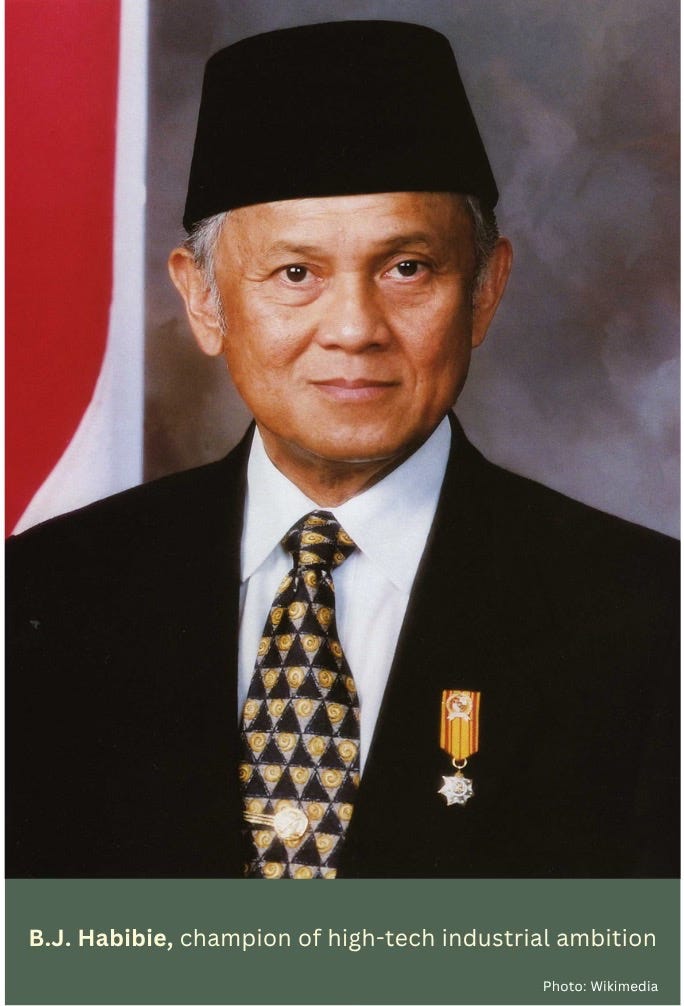
Their man was B. J. Habibie, a German-trained aeronautical engineer and a Suharto favourite. Their road was a matter of national pride: skip the cheap stuff, build the hard, high-technology industries, make your own planes and steel.5 When the two camps clashed in the open, Suharto sided with the engineers, backing Habibie against the economists’ loud, public objection that plane-building made no economic sense.
The usual way to explain a country that climbs and then stops short is to set it beside another that did not, and name what the second had that the first lacked. The natural comparison is Korea, which started just as poor and made the leap Indonesia never did. But two countries differ in a thousand ways, and any of them could be the reason one pulled ahead.
Indonesia narrows the guesswork. It ran both roads on itself, the policy changing while the institutions, the ruling coalition and the resource base all held still underneath, which is about as close as development comes to a natural experiment in whether the road is what decides.
The whole debate assumes the two roads lead to different places. In Indonesia, they led to the same outcome. Under both, the economy climbed to the same middle-income plateau and then stopped. If a thing can change while the result stays the same, it was not the thing deciding the result.
The road changed. The plateau did not. So the road was not the cause.
It is not a clean laboratory. Neither road was ever run as an economy-wide programme; the reforms reached the open sector while the favoured firms sat in their protected niches, often at the same time. So it does not isolate a cause the way a real experiment would.
But what it does show is narrower, and it holds whichever camp held the pen. One set of firms stayed exactly where it was, untouched, and the plateau never moved with the road.
One distinction does the work here. There are two very different disciplines in this story. One is discipline over the books, holding down inflation, debt and the budget, which Indonesia ran superbly. The other is discipline over firms, making the companies meant to carry the economy improve or fail. That second kind is not something only a strong state can impose; an open market delivers it too. So the question is not simply state versus market. It is whether anything, by any route, ever forced a leading Indonesian firm to get better or get out.
The same test, withheld two ways
What separates the economies that arrive from those that stall is not ambition, nor money for champions. It is a test that a leading firm can actually fail, and be made to pay for failing.
Two things can impose it. A market imposes it from the outside by allowing a firm that cannot compete to lose customers and go under. A state imposes it from the inside, through the machinery that carries a decision from the top down to the single firm, its governing circuit. It backs a firm, then pulls the backing the moment the firm underperforms. Either way, something has to be willing to let the weak firm lose.
Indonesia’s two roads look like opposites. The market picks the winners, or the state does. But beneath the policy, the governing circuit never changed. Whichever road the country was on, the same machinery sorted its firms the same way, and it kept the connected core, the big conglomerates tied to the people in power, beyond the reach of any condition at all.
The free-market road withheld the test one way. The reformers freed trade and finance, and the market’s discipline did reach the open sector, the part of the economy exposed to foreign competition. The firms there were made to compete, and many did well. But that sector was mostly foreign-owned, so it improved firms that were not Indonesian. It was real, but the company it sharpened belonged to someone abroad.
The connected core sat in protected niches the circuit never opened to that competition. A market can only discipline the firms it can reach, and these the state kept out of reach.
The build-champions road withheld the test the other way. Here the circuit was generous, backing its chosen firms lavishly. But it attached no condition any of them could fail. It gave, and never once threatened to take back.
Whichever camp held the pen, the connected core never faced a condition it could fail.
It shows up inside a single firm. The Salim group was the largest of the connected conglomerates.6 When the economists freed finance, its bank gorged on cheap credit. When the engineers built champions, its other arms drew protected rents, the easy profits a sheltered position throws off. Two different roads, two different sources of advantage, and under neither did any part of it ever face a test it could fail.
Salim was not a weak firm being carried. It was an exceptional one, superbly good at the only thing the system actually rewarded: staying close to power and turning that closeness into cheap money and protected markets. A firm like that did not need fixing. It was already excellent, at the wrong thing.
This is what the missing test looks like when it is present. South Korea, in the same years, made even its largest firms export or die: meet a hard external standard or lose the support.7
Korea’s version was neither clean nor permanent. The same directed credit left its big firms dangerously over-borrowed by 1997, and the export test was one part of a longer recipe that ran through land reform and a tightly held financial system. The point that matters here is narrower and survives all of that: a leading Korean firm faced an external standard it could actually fail to meet, and the leading Indonesian ones, on either road, never did.
The machine worked
The objection to meet is that it could not. Disciplining firms is hard, harder than managing a budget. Perhaps the governing circuit, for all its reach, was never strong enough to make a favoured firm sink or swim, and “never built it” is a polite way of saying “was never able to.”
The answer is a single date. In 1975, the company that ran Indonesia’s oil nearly took the country down with it.
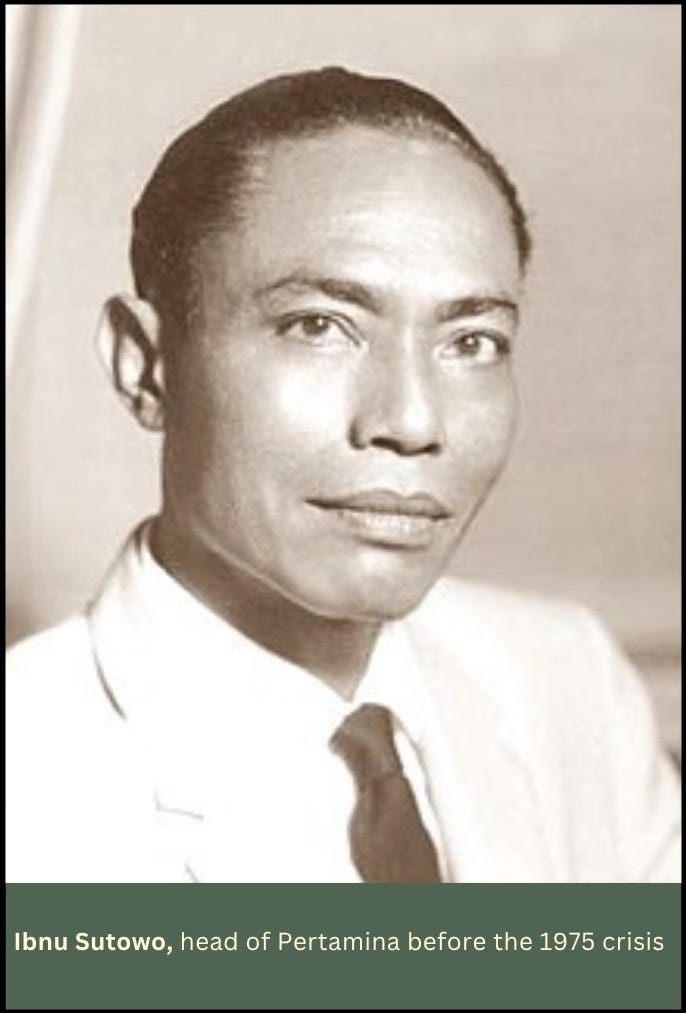
Pertamina was run by a general, Ibnu Sutowo, who, through the early 1970s, had turned it into an empire of hotels, steel mills and a rice estate, borrowing quietly to do so.
In February 1975 it could not repay a short-term loan, and the hidden total surfaced: around US$10.5 billion, close to a third of the entire economy.8 The economists running the budget did not flinch. They took the debt onto the state’s books, broke up the empire, and removed Sutowo.
That is not a weak state. That is a government reaching down and culling its single largest champion, fast, to protect the nation’s finances. That is the governing circuit at work, the machine that runs from the top of the state down to a single firm. It plainly existed, and it could reach the very top.
The question is not whether Indonesia could run a test. It did run one, and ran it well. The question is what the condition was for. And here is what the Pertamina rescue quietly reveals. The circuit selected on solvency, never on productivity. Sutowo was removed for threatening the nation’s finances, not for failing to build anything good.
It was aimed elsewhere
Aimed at productivity, the same circuit would have produced the opposite of what Indonesia did. IPTN, the state aircraft company Habibie built, is the inverse case.

Over its life, the state poured billions into it, with no clean year-by-year total to pin down. It never had to win over a real customer; its planes went at a loss to state airlines that had little choice. When money ran short for its flagship jet in 1994, the government quietly moved US$185 million out of a reforestation fund to keep it going.9 The engineering was rarely the problem; turning it into an aircraft a buyer would actually choose was the condition it had to meet.
A firm that threatened the budget got the Pertamina treatment. A firm that lost money for decades building planes nobody bought got another grant. The list runs on. The same decade handed a presidential son a clove monopoly, gave a Suharto friend the entire plywood export trade, and built a national car that turned out to be a rebadged Korean Kia. Each was sheltered. None was ever asked to earn the shelter.
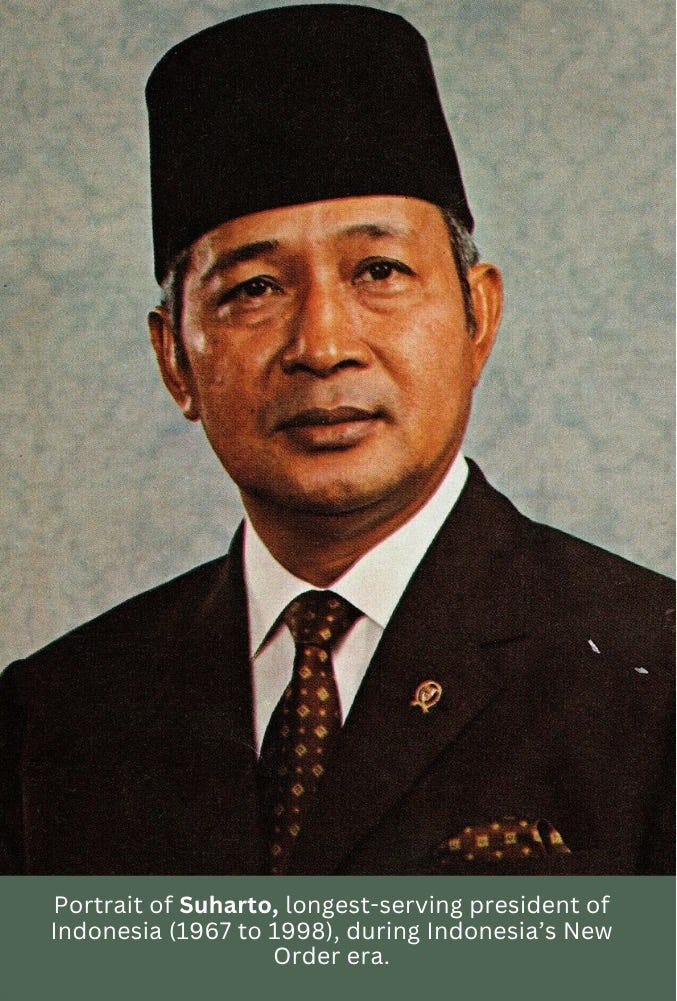
The pattern has a precise, testable form. Across the New Order, Suharto’s three decades in power, I can find no connected-core firm that was ever cut off from state support for failing to compete.10 The open sector is another matter: there, foreign-owned exporters were disciplined all the time, by their buyers.
To break the claim, you would need a single, connected champion whose protection (its tariff wall, captive procurement, directed credit, or monopoly licence) was stripped away for missing its targets while it was still solvent. A firm cut loose because it was going broke, or because its patron fell from favour, does not count; that is solvency or palace politics, not whether the firm was any good.
Why the circuit was aimed at solvency
If the state could run the governing circuit and aim it at solvency, the question becomes: why? The answer is not a mistake or an oversight. It is interest.
Suharto’s rule rested on keeping a particular set of people loyal: the generals, the Chinese-Indonesian business families who financed the regime, and in time his own children. They were the coalition, the base whose backing kept him in power, and the bargain that held them together was the country’s political settlement: the left destroyed, the unions broken, the press tamed, the army inside the government, and the technocrats kept in a protected circle of their own.11
The favoured firms were not bystanders to that coalition. They were it. So a condition that could make a connected firm fail was not a neutral tool the state had neglected to build. It was a weapon, and it could point only at the regime's own base.
That is why the regime enforced one discipline ferociously and refused to enforce the other. The macro kind defended that base. The whole arrangement ran on the state’s solvency: the subsidies, monopolies and cheap loans the coalition lived on all flowed from one pool, the oil money and the public budget, and a bankrupt state has nothing to pay out. So when Pertamina’s borrowing threatened to drain that pool dry, removing Sutowo did not attack the coalition. It defended it.
A productivity condition cut the other way. It would have done nothing to protect the pool and would have been taken directly from a single favoured firm. Worse, it would have changed what a place in the coalition was worth. That place was a guaranteed return that never depended on being any good; a test a firm can actually fail makes it conditional: perform or lose the support, which is exactly what Korea did when it told even its biggest firms to export or die.
Held to that standard, any Indonesian insider could be cut. The bargain that bound the coalition promised security; a productivity test offered risk, for an economy-wide gain the coalition did not capture. A government does not build the one instrument that would break it. That is Mushtaq Khan’s point about political settlements, seen on the factory floor: a ruling coalition can sustain only the disciplines its own survival permits.
So “could not” is the wrong answer.
The circuit could reach the top, as Pertamina showed, and the nerve to use it was there. What stopped a productivity test was not a missing skill but a standing interest. Turning that instrument on a connected firm would have starved the coalition that was the regime. Whether Indonesia could also have mastered the harder, different craft of judging firms on what they made is a question it never had reason to ask.
The rules relaxed for the connected
The windfall the technocrats managed so well was also what paid for the coalition’s loyalty, and did so without conditions. The regime could keep its base content with shelter and rents straight out of the oil account, so it never had to make those firms productive in order to afford them. That is a quieter curse than the one that wrecked Nigeria. The oil did not bloat the currency and choke off industry here; it bought the regime the freedom never to discipline the industry it had.
The kind of regime Suharto ran is not the difference; it’s worth comparing with two states of the same kind. South Korea and Taiwan were no gentler: all three were hard authoritarian states that jailed opponents and tolerated little dissent.12 The difference between them and Indonesia was never how hard the state could be. It was on whom it was willing to be hard. Korea was willing to be hard on its biggest firms.
Indonesia was willing to be hard on anything except them.
The question usually asked of a whole country can be put to a single firm. Not whether a nation’s institutions are open or closed, but whether one connected firm inside it could ever be allowed to fail for being no good at what it did. In Indonesia, over thirty years and on both development paths, the answer was no. Not because the state lacked the nerve to enforce it, but because the firm that would fail such a test was, in the end, the regime itself.
What a state is built to reward
Indonesia had every piece a developmental state is supposed to have: the declared intent to build industry, the costly commitments paid to back it, and a governing circuit that plainly worked, the machinery that culled Pertamina in 1975. Nothing was missing.
The trouble was that all of it pointed one way. The intent was loudest in the boom years, exactly when champions were handed support with no condition attached; the commitments were paid to steady the nation’s books; and the circuit, when it reached down, reached for solvency. Every piece was aimed at the nation’s finances.
All three stopped at the same line, and for the same reason. A firm-level condition would have fallen on the connected core, which was the coalition. So the intent could be declared but never enacted, the commitments paid but never to make a single firm improve, the circuit built but never aimed at whether a firm was any good, because all three, turned that way, would have broken the base the regime stood on.
And the arrangement renewed itself. Sheltering the core was exactly what kept the core loyal, so every year of protection made the next year’s protection more necessary, not less. The thing that made it impossible was the same thing it would have destroyed.
And no force inside the system pushed the other way, either. In the countries that broke open, it was a homegrown export sector that did the breaking: firms that had passed the world’s test and grown strong on it eventually had the weight, and the reason, to force the closed arrangement open and demand the same rules for everyone.
Indonesia got the boom but not the bloc. After the mid-1980s reforms, a real export industry emerged: garments, footwear, and electronics. By the early 1990s, manufactured goods had risen from around 2 per cent of the country’s exports to about half. But it ran on foreign factories chasing cheap labour, not on firms Indonesia owned, and its momentum faded before any home-grown champion grew strong enough to demand anything. The force that elsewhere cracks a closed system from the inside never formed.13
Three things, then, and one direction. The governing circuit, the machine that runs from the palace to the factory floor, has a reach and a direction. Its reach was never in doubt; Pertamina settled that. Its direction had a name. The country’s governing orientation is not what a government wants but what it actually rewards and refuses to rescue, read off the cases rather than the speeches.
A country gets the economy it honours, and Indonesia honoured the men close to the palace and the symbols of a modern nation, never the unglamorous business of being better this year than last. The closer a firm sat to power, the safer it was from ever having to improve.
The settlement on the factory floor
The theory of political settlements already explains a ruling coalition can sustain only the disciplines its survival permits. What the case adds is two things that theory describes but does not supply. It gives a way to see that constraint, and a way to test it.
The first is a way to see it. Governing orientation is the firm-level signature of the settlement, read off what the state rewards and refuses to rescue rather than off the distribution of power above it. The constraint stops being something you infer from politics and becomes something you can read on the factory floor.
The second is a way to test it. With the settlement, the coalition and the resource base held fixed and only the policy road varying, Indonesia’s own swing back and forth shows the orientation sitting underneath the road, not set by it. Between them, the two moves make the settlement’s grip observable and testable rather than merely asserted.
A more capable state, the objection runs, could have done both, sheltered its coalition and still disciplined its firms. It could not. A state strong enough to cull a failing firm is strong enough to shelter a favoured one, and Suharto’s used that strength to shelter. The discipline that actually transforms an economy is the kind no government can quietly switch off, the kind an open market imposes and no palace phone call can lift.
The call did not need to lift it. Its work came earlier, in keeping the connected core out of the open market at all, so the market’s discipline never reached the firms that mattered. To shelter a firm was to take it out of the one discipline that would have transformed it, so no state, however capable, could do both at once.
In Indonesia, almost nothing was ever beyond the reach of that phone call.
The argument that missed the point
The famous thirty-year argument between Indonesia’s free-marketeers and its industrial planners was an argument about the wrong thing. Both sides were fighting over which road to take. Neither was fighting over the only question that separates the countries that arrive: whether any firm on either road could ever be made to fail. The road was never the variable. What the state was built to reward was.
And the lesson is not that Indonesia lacked discipline. The intent to build industry turned into one condition, the nation’s ability to pay its bills, never a condition that a company be any good at what it made. That translation, what a state’s stated purpose becomes in the things it actually rewards, is its governing orientation. Discipline is not a quantity a state has more or less of; it is an aim, and Indonesia’s was fixed on solvency, never on productivity.
This is also where the story’s one ugly debt has to be named. The freedom that let Suharto’s economists act so decisively rested on the mass killings of 1965 and 1966 and the silencing of everyone who might have objected. It is a set-aside cost, but it should not be buried.
The diagnosis leaves a harder question behind it. A state this competent could have aimed the circuit at productivity, and chose not to, in the only sense that matters, because the firms it would have broken were the base the regime stood on. To turn it on them, Suharto would have had to remake that base, the settlement his own power rested on.
That is exactly what the leaders who transformed their countries did. Park Chung-hee reset the terms by which Korea’s big firms operated when he made them export or die. It is the choice a transformation demands, and the one Suharto would not make.
Why a country that managed everything else so well never made it, and what the gap finally cost when the reckoning came, is the rest of the story.
Further reading
Studwell, Joe, How Asia Works (2013) — the export test the transforming economies forced on their firms, the discipline Indonesia never imposed.
Amsden, Alice H., Asia’s Next Giant: South Korea and Late Industrialization (1989) — the canonical account of the disciplined-state model Indonesia is measured against.
Acemoglu, Daron & James A. Robinson, Why Nations Fail (2012) — the institutions-and-growth frame the post leans on when it sets aside regime type as the differentiator.
Schwarz, Adam, A Nation in Waiting: Indonesia in the 1990s (1994) — an accessible political history of the New Order and the coalition behind it.
Hill, Hal, The Indonesian Economy since 1966: Southeast Asia’s Emerging Giant (1996) — the standard economic history of the New Order.
Bresnan, John, Managing Indonesia: The Modern Political Economy (1993) — the first book-length political-economy history of the New Order.
Masina, Pietro, Indonesia essays at pietromasina.substack.com
Notes
Depending on which series you trust, the 1965–66 inflation peak lands anywhere from about 600 per cent to over 1,000. I’ve taken the cautious end; the figure usually quoted for 1966 is around 635 per cent.
Among the oil states of its day, Indonesia is the textbook exception to the resource curse: the same windfall that wrecked Nigeria and Venezuela somehow did not wreck it.
I’ve used the 60-per-cent-in-1970 baseline here. The official series starts later, in 1976, and runs from roughly 40 per cent down to 11 — a different starting point but the same long fall. The one thing not to do is mix the two.
The nearest things to a counterexample are Polytron, an own-design electronics maker now edging into chip design, and Polygon, a bicycle brand that sells worldwide. Neither is a world technology leader of the Samsung or TSMC kind, which is the bar that matters here.
The economists-versus-engineers fight swung on a pendulum, and the pendulum was the oil price: the economists rose in the busts of 1966, 1975 and the mid-1980s, the engineers in the booms.
The Salim group is the cleanest single example. Run by Liem Sioe Liong (Sudono Salim), Suharto’s closest business associate, it fed under both roads at once: its bank, Bank Central Asia, gorged on cheap credit when finance was freed, while its flour and cement arms, Bogasari and Indocement, lived comfortably off protected rents.
How much of Korea’s success the discipline really explains is genuinely contested. One camp reads East Asian growth as mostly sweat and piled-up capital, and the same directed credit later left the big firms dangerously over-borrowed when 1997 hit. The point here is the narrow one: the discipline was real enough to drive transformation, not that it was flawless.
That “close to a third of the economy” line is only there to give the US$10.5 billion a sense of scale. Set the debt against the size of the whole economy at the time, and you can sense how big the hole was.
The IPTN total is a pieced-together, cumulative estimate, drawn from reporting and industry analysis rather than any clean year-by-year budget, which does not exist.
A negative claim like this can never be proved, only left standing or knocked down, which is why the bar for refuting it is set so precisely. The protected position of the connected core is well documented; the firm-level negative is my own reading of it, put up for testing.
Spelled out more fully, the New Order settlement looked like this: the 1965–66 destruction of the Communist party and the organised left, tame unions and a tamed press, the army wired into government through its dwifungsi or “dual function”, Golkar as the regime’s election machine, Chinese-Indonesian business money tied to the centre, and the technocrats kept in a protected bubble under Suharto’s personal cover.
The inclusive-versus-extractive idea this leans on is really about institutions, not about democracy versus dictatorship.
This is the “deals and development” framework of Pritchett, Sen, and Werker: a developing economy runs on personal deals rather than impersonal rules, and a closed system opens only when a bloc of globally competitive firms grows strong enough to force it to open. Placing Indonesia in their “ordered but closed” box, stable enough to invest in, with the best deals kept for insiders, is my own application of their scheme.
This is an excellent and thought-provoking essay. Stephen Brien succeeds in shifting the debate away from the familiar opposition between market-oriented reforms and state-led industrial policy, and toward a more fundamental question: what kinds of firms and behaviours the state actually rewards. His concept of a "governing orientation" is a particularly useful way of connecting macroeconomic performance, industrial outcomes, and political coalitions.
There are important points of convergence with my own work on Indonesia. I also argue that the country's developmental trajectory cannot be understood simply through the lens of policy choices or institutional design. The political foundations of growth matter, as do the interests and coalitions that shape state action. Stephen's emphasis on the inability—or unwillingness—of the New Order to discipline politically connected firms offers a powerful explanation for why Indonesia achieved remarkable growth and poverty reduction while failing to generate globally competitive national champions.
Where I would place a somewhat different emphasis is on the broader historical and social context of Indonesia's development. In my view, the weakness of domestic productive capabilities was not only a consequence of elite incentives and political settlements, but also of the way Indonesia was integrated into the global economy, the legacy of labour repression, and the limited development of institutions capable of fostering technological learning and innovation. The absence of effective firm-level discipline was certainly important, but it interacted with wider structural constraints.
Nevertheless, I believe Stephen's essay makes a significant contribution by bringing the discussion back to a crucial question that is often overlooked: not whether the state intervenes, but whether it can create incentives that reward productivity, learning, and technological upgrading rather than political proximity. It is a valuable contribution to the debate on why Indonesia's impressive developmental achievements stopped short of full industrial transformation.
Thus 'discilpining' firms, often presented as an innocently rational and technocratic act, in reality is a highly political one with grave, possibly fatal, consequences for the regime bold enough to attempt it. Safer to be satisfied with permanent middle income status!